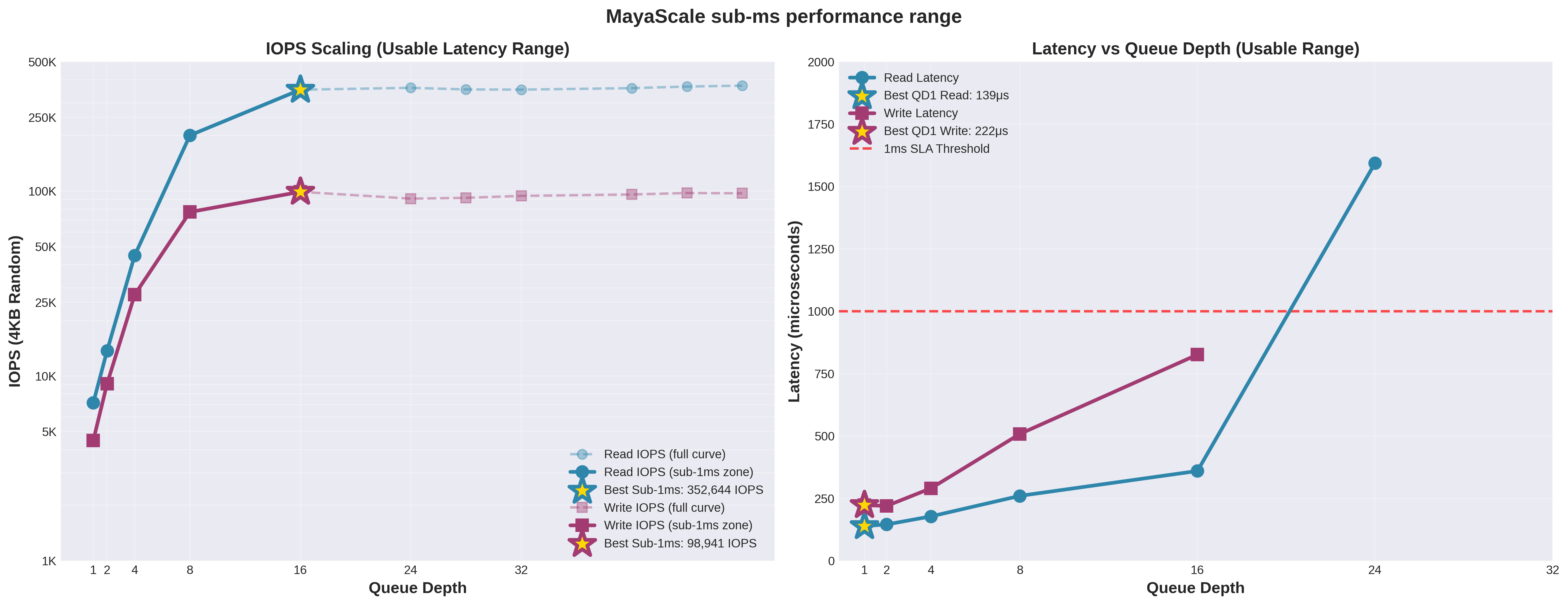
Azure's new Laosv4 instances are a game-changer for storage-intensive workloads, and MayaScale delivers exceptional performance on this platform—140 microsecond read and 220 microsecond write latency with shared storage that rivals direct-attached NVMe.
Azure's Laosv4: A Major Step Forward
Microsoft recently announced the general availability of Azure L-series storage-optimized VMs, including the Laosv4, Lasv4, and Lsv4 families. These instances provide local NVMe SSDs optimized for high-throughput, low-latency workloads like NoSQL databases, data warehousing, and big data applications.
While Azure's L-series VMs provide excellent local storage, MayaScale takes performance further by pooling these NVMe resources across multiple VMs using NVMe-over-Fabrics (NVMe-oF), delivering shared storage with latency that rivals direct-attached storage.
Performance Breakthrough
In recent testing on Azure L4aos_v4 instances (4 vCPU, 3x NVMe drives, 10 Gbps network), MayaScale achieved remarkable sub-millisecond latency performance that approaches direct-attached NVMe speeds while providing the flexibility of shared network storage.
Validated Performance Metrics
SLA Guarantee Points (Sub-1ms)
These metrics represent queue depth 1 (QD1) performance—the most important metric for real-world applications. Unlike synthetic benchmarks at high queue depths, QD1 performance reflects what your applications actually experience.
Technical Architecture
Test Configuration
Our validation used Azure's Standard tier (L4aos_v4 instances):
- Instance Type: L4aos_v4 (4 vCPU, 32 GB RAM)
- Local Storage: 3x NVMe drives (2.88 TB total capacity)
- Network: 10 Gbps accelerated networking
- Configuration: Active-Active with server-side replication using Linux MD RAID-1
- Protocol: NVMe-over-TCP (NVMe-oF)
Why These Numbers Matter
Traditional network storage typically delivers 1-5ms latency. Cloud block storage (like Azure Premium SSD) provides 2-10ms latency. MayaScale's sub-millisecond latency (0.14ms read, 0.22ms write) represents a 10-50x improvement over traditional solutions.
This performance level makes MayaScale suitable for applications previously requiring direct-attached storage:
- High-frequency trading systems - Where microseconds matter
- Real-time analytics - Processing data as it arrives
- NoSQL databases - Cassandra, MongoDB, ScyllaDB with ultra-low latency requirements
- In-memory databases - Redis, Memcached with persistent storage
- AI/ML training - Fast data loading for GPU workloads
Understanding the Performance Curve
An interesting finding from our testing: write IOPS peaked at 99,000 IOPS before plateauing. This isn't a storage limitation—it's a network bandwidth ceiling. With server-side replication, write traffic doubles (data written to both nodes), consuming approximately 6.4 Gbps at peak, approaching the 10 Gbps network limit of the Standard tier.
For applications requiring higher write IOPS while maintaining sub-millisecond latency, Azure's higher-tier L-series instances (with 25-50 Gbps networking) will scale accordingly. The sub-1ms latency SLA remains consistent across all tiers—it's a function of the NVMe devices and NVMe-oF protocol, not network bandwidth.
Getting Started
MayaScale is available on Azure Marketplace and can be deployed in minutes. The solution includes:
- Automated deployment via Azure Resource Manager (ARM) templates
- Active-Active high availability with automatic failover
- NVMe-oF client drivers for Linux (RHEL, Ubuntu, CentOS)
- Performance monitoring and management tools
- Free trial available for evaluation
MayaScale automatically configures the optimal settings for your chosen Azure L-series instance type, ensuring you achieve the lowest possible latency for your workload.
Why MayaScale on Azure L-Series?
Ultra-Low Latency
Sub-millisecond response times that rival direct-attached storage
High Availability
Active-Active configuration with automatic failover and data replication
Elastic Scaling
Add storage capacity or performance by adding nodes—no downtime required
Conclusion
Azure's Laosv4 series represents a game-changing step in the right direction for storage-intensive cloud workloads. With generous local NVMe capacity even on smaller instances and improved architecture over previous L-series generations, Microsoft has delivered a platform that truly competes with the best offerings from GCP and AWS.
MayaScale is purpose-built to deliver the best out of these new Laosv4 instances. By pooling local NVMe storage across nodes while maintaining sub-millisecond latency (140μs read, 220μs write), we bridge the gap between direct-attached storage performance and shared network storage flexibility. Applications that previously required expensive specialized hardware can now run efficiently on Azure's cloud infrastructure.
The combination of Azure's Laosv4 hardware and MayaScale's software creates a compelling solution for databases, analytics, and data-intensive workloads that demand both high performance and high availability.
Ready to Experience Sub-Millisecond Storage?
Try MayaScale on Azure today with our free trial. Deploy in minutes and see the performance difference for yourself.
Download Free Trial View on Azure Marketplace