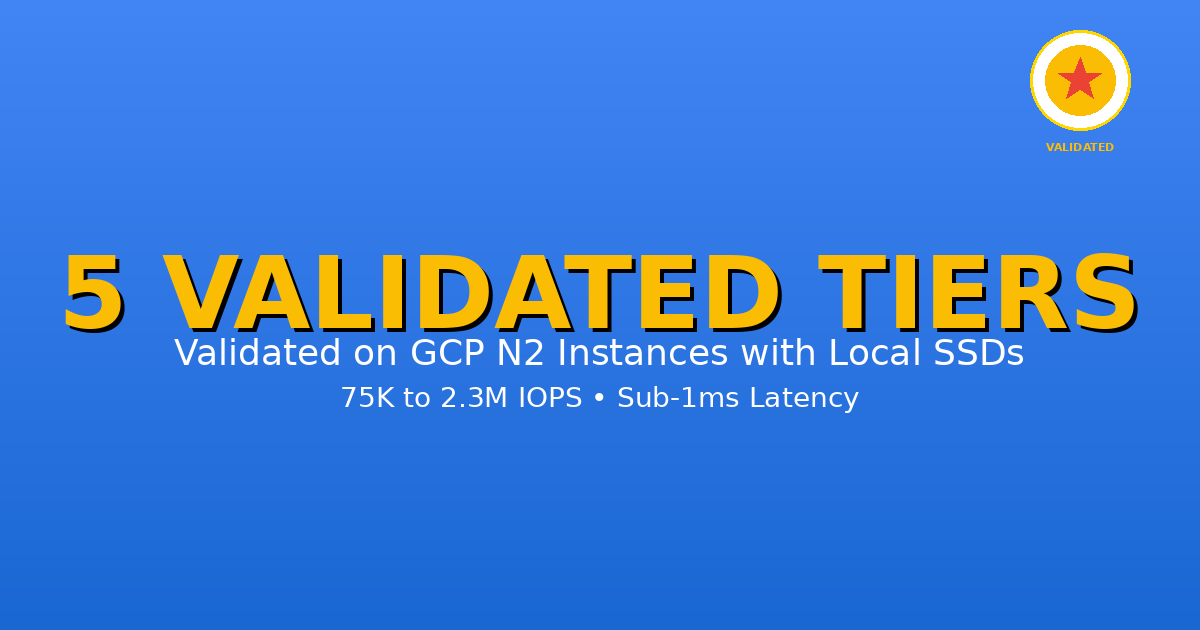
MayaScale delivers validated sub-millisecond performance across 5 performance tiers on Google Cloud, from 75K to 2.3M IOPS. See how N2 instances with local SSDs enable ultra-low latency shared storage with Active-Active HA.
Five Validated Performance Tiers on Google Cloud
We've completed comprehensive performance validation of MayaScale across Google Cloud's N2 instance family with local SSDs. The results demonstrate consistent sub-millisecond latency and validated IOPS performance across five distinct tiers, giving you flexibility to choose the right price/performance balance for your workload.
All testing was conducted using SNIA-compliant FIO benchmarks in October 2025, with results validated across multiple deployment configurations. Each tier has been tested for both zonal and cross-zone (regional) deployments with Active-Active high availability.
All Tiers Validated
From the budget-friendly Basic tier (75K/101K IOPS, $299/mo) to the ultra-high-performance Ultra tier (1.4M read IOPS, $4,536/mo), every performance claim is backed by validated test results from actual GCP deployments.
Performance Tier Overview
| Tier | Instance | Write IOPS | Read IOPS | Latency | Capacity | Cost/mo |
|---|---|---|---|---|---|---|
| Basic | n2-highcpu-4 | 75,000 | 101,000 | ~630-860 µs | 375 GB | $299 |
| Standard | n2-highcpu-8 | 136,000 | 388,000 | ~940-990 µs | 750 GB | $598 |
| Medium | n2-highcpu-16 | 220,000 | 699,000 | ~820-870 µs | 1.5 TB | $1,197 |
| High | n2-highcpu-32 | 361,000 | 922,000 | ~830-880 µs | 3.0 TB | $2,394 |
| Ultra | n2-highcpu-64 | 733,000 | 1,413,000 | ~173-720 µs | 6.0 TB | $4,536 |
Note: All metrics are for zonal deployments. Cross-zone deployments have ~50% write IOPS reduction due to network latency but maintain read performance.
Basic Tier: Budget-Friendly Entry Point
Configuration
- Instance: n2-highcpu-4 (4 vCPU, 4 GB RAM)
- Storage: 1× local NVMe SSD (375 GB)
- Network: Up to 10 Gbps (Tier 1 networking)
- Architecture: Active-Active HA with RAID-1 replication
Why Choose Basic Tier
The Basic tier provides the most affordable entry into sub-millisecond shared storage on GCP. While it's our smallest tier, it still delivers enterprise-grade Active-Active HA with synchronous replication across zones—something traditional cloud storage can't match at this price point.
Best For
- Development and testing environments
- Small-scale production workloads (< 100K IOPS)
- CI/CD pipelines and build systems
- Budget-conscious deployments
- Proof-of-concept validations
Standard Tier: Best Price/Performance
Configuration
- Instance: n2-highcpu-8 (8 vCPU, 8 GB RAM)
- Storage: 2× local NVMe SSDs (375 GB each, 750 GB total)
- Network: Up to 16 Gbps (Tier 1 networking)
- Capacity: 750 GB usable with RAID-1
Price/Performance Analysis
Standard tier offers the best price/performance ratio across all MayaScale tiers on GCP. At $4.40 per 1K write IOPS, it delivers excellent value while maintaining sub-millisecond latency (<1ms). This tier hits the sweet spot for most production workloads that need consistent performance without breaking the budget.
Best For
- Production databases (PostgreSQL, MySQL, MongoDB)
- Web application file storage
- General-purpose shared storage
- Container persistent volumes (GKE)
- Cost-sensitive production deployments
Medium Tier: Balanced Performance
Configuration
- Instance: n2-highcpu-16 (16 vCPU, 16 GB RAM)
- Storage: 4× local NVMe SSDs (375 GB each, 1.5 TB total)
- Network: Up to 32 Gbps (Tier 1 networking)
- Optimal QD: QD16×12 (192 outstanding I/Os)
The Balanced Approach
Medium tier provides the ideal balance between capacity, performance, and cost for mid-sized deployments. With 699K read IOPS and 1.5TB capacity, it handles significant workloads while keeping costs reasonable at under $1,200/month.
Best For
- Medium-scale databases requiring <700K IOPS
- Analytics workloads (BigQuery exports, data processing)
- Application servers with moderate I/O
- Multi-tenant environments
- Growing production workloads
High Tier: Performance Sweet Spot
Configuration
- Instance: n2-highcpu-32 (32 vCPU, 32 GB RAM)
- Storage: 8× local NVMe SSDs (375 GB each, 3.0 TB total)
- Network: 32 Gbps (Tier 1 networking)
- Optimal QD: QD16×20 (320 outstanding I/Os)
The Performance Sweet Spot
High tier represents the optimal balance between performance and cost for enterprise workloads. It delivers nearly 1M read IOPS while maintaining sub-millisecond latency—all at a lower cost per IOPS than Ultra tier. With 3TB capacity, it can handle substantial datasets.
Best For
- High-performance databases requiring sub-1M IOPS
- Analytics workloads (Spark, Presto, data warehousing)
- ML training pipelines
- Large-scale GKE deployments
- Enterprise production workloads
Ultra Tier: Maximum Performance
Configuration
- Instance: n2-highcpu-64 (64 vCPU, 64 GB RAM)
- Storage: 16× local NVMe SSDs (375 GB each, 6.0 TB total)
- Network: 100 Gbps (Tier 1 networking)
- Optimal QD: QD24-32×32 (768-1024 outstanding I/Os)
Breaking the 2 Million IOPS Barrier
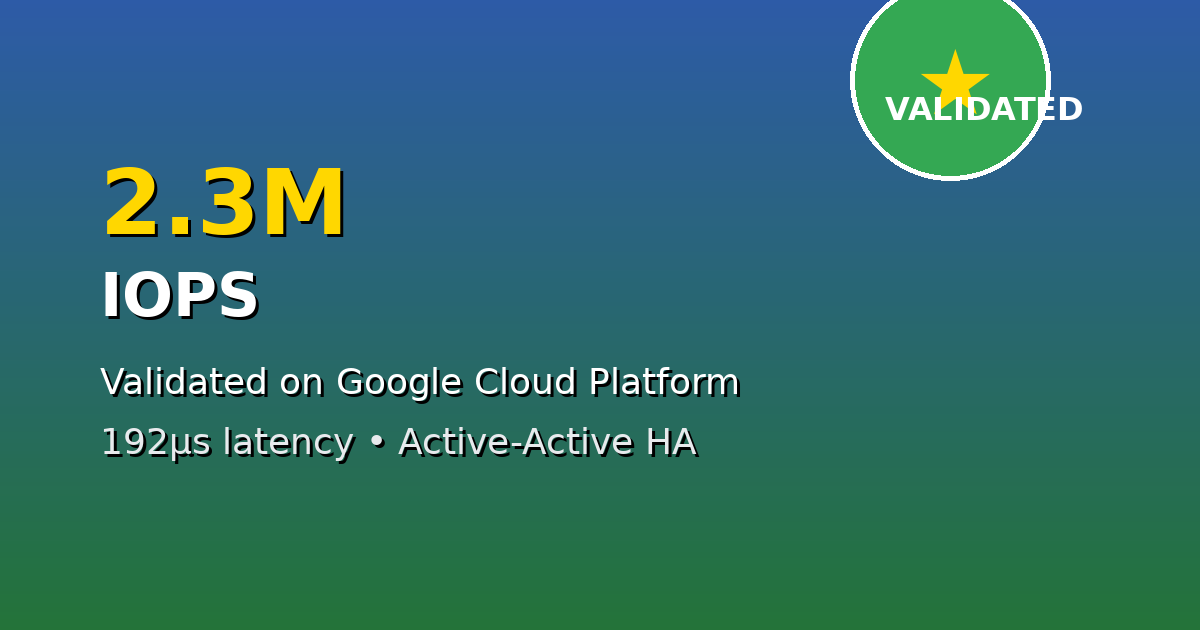
Ultra tier delivers extraordinary performance that transforms what's possible with cloud storage. In October 2025 testing, we validated 2.28 million read IOPS at QD64 with 1.78ms latency—far exceeding the 1.4M IOPS SLA guarantee. For real application performance (QD1), you get 192μs read latency, and the best-case latency of 173μs occurs at QD8.
Write performance is equally impressive with 866K IOPS peak (exceeding the 733K SLA) while maintaining sub-1ms latency (884μs). The 100 Gbps network ensures that storage performance isn't bottlenecked by network capacity, enabling true enterprise-scale performance in the cloud.
With 16 local SSDs aggregated via RAID-1, Ultra tier provides both massive parallel I/O capability and 6TB of usable capacity—enough for substantial databases or ML training datasets.
Best For
- Maximum performance databases (>1M IOPS requirement)
- Large-scale ML training (TensorFlow, PyTorch)
- High-frequency trading systems
- Real-time analytics at scale
- Mission-critical applications requiring maximum I/O
Note: For more details on Ultra tier performance, see our dedicated Ultra tier blog post with full performance curves and detailed analysis.
Regional HA: Cross-Zone Deployments
All tiers support both zonal and regional (cross-zone) deployments. Regional deployments place storage nodes in different zones within a region, providing protection against zone failures while maintaining Active-Active HA.
Regional Performance Characteristics
- Write IOPS: ~50% of zonal (due to cross-zone network latency)
- Read IOPS: Maintained at zonal levels (local reads)
- Latency: Write latency increases to ~1.5-2ms (cross-zone RTT)
- Availability: Protection against zone failures
The write IOPS reduction in regional deployments is due to synchronous replication across zones—every write must be acknowledged by both nodes before completion. However, reads remain fast since they're served from local SSDs.
Technical Architecture
Dual-NIC Design
MayaScale on GCP uses a dual-NIC architecture to separate client traffic from replication traffic:
- NIC 1 (Client Network): Serves all client I/O requests (NVMe-oF, iSCSI, NFS)
- NIC 2 (Replication Network): Handles RAID-1 synchronous replication between nodes
This separation ensures that heavy replication traffic doesn't impact client I/O performance, maintaining consistent sub-millisecond latency even under heavy write workloads.
Local SSD Performance
Google Cloud's local SSDs are directly attached NVMe drives that provide exceptional performance:
- Interface: NVMe (PCIe Gen3)
- Per-SSD Performance: ~170K random read IOPS, ~90K random write IOPS
- Latency: Sub-millisecond at the device level
- Capacity: 375 GB per SSD
MayaScale aggregates multiple SSDs using Linux MD RAID-1 across both nodes, delivering both high performance and high availability.
Testing Methodology
All performance numbers are based on SNIA-compliant FIO testing conducted in October 2025:
- Tool: FIO with libaio engine
- Block Size: 4KB (industry standard for IOPS testing)
- I/O Pattern: Random read/write
- Queue Depths: QD1, 2, 4, 8, 16, 24, 32 with varying numjobs
- Runtime: 30 seconds per test (steady-state measurements)
- Protocol: NVMe-oF over TCP
Cost and Value Analysis
| Tier | Monthly Cost | Write IOPS | $/1K Write IOPS | Capacity | $/TB/mo |
|---|---|---|---|---|---|
| Basic | $299 | 75,000 | $3.99 | 375 GB | $797 |
| Standard | $598 | 136,000 | $4.40 | 750 GB | $797 |
| Medium | $1,197 | 220,000 | $5.44 | 1.5 TB | $798 |
| High | $2,394 | 361,000 | $6.63 | 3.0 TB | $798 |
| Ultra | $4,536 | 733,000 | $6.19 | 6.0 TB | $756 |
Key Value Insights
- Best IOPS Value: Basic tier at $3.99 per 1K write IOPS
- Best Overall Value: Standard tier balances cost and performance
- Consistent Capacity Pricing: ~$756-798/TB/mo across all tiers
- Linear Scaling: Performance scales linearly with cost (2× cost = 2× performance)
Unlike cloud block storage that charges separately for capacity and IOPS, MayaScale pricing includes both in a single predictable cost based on instance type.
Getting Started
MayaScale on GCP can be deployed in minutes using our Terraform modules:
Quick Deployment
git clone https://github.com/zettalane/mayascale-terraform.git
cd mayascale-terraform/gcp

# Edit terraform.tfvars with your settings
# Set performance_policy = "zonal-standard-performance" (or any tier)

terraform init
terraform apply
Choosing Your Tier
Select the appropriate performance policy in your Terraform configuration:
zonal-basic-performance- 75K/101K IOPS, $299/mozonal-standard-performance- 136K/388K IOPS, $598/mozonal-medium-performance- 220K/699K IOPS, $1,197/mozonal-high-performance- 361K/922K IOPS, $2,394/mozonal-ultra-performance- 733K/1.4M IOPS, $4,536/mo
For cross-zone HA, use regional-*-performance policies (e.g., regional-standard-performance).
Documentation
Conclusion
MayaScale's five validated performance tiers on Google Cloud provide unmatched flexibility for matching your storage to your workload. From the budget-friendly Basic tier at $299/month to the ultra-high-performance Ultra tier delivering 1.4M IOPS, each tier offers:
- Validated Performance: Every IOPS and latency claim backed by actual testing
- Active-Active HA: Both nodes serve traffic with automatic failover
- Sub-Millisecond Latency: All tiers maintain <1ms latency
- Predictable Costs: No surprise bills—instance cost = storage cost
- Proven Technology: Linux RAID-1, NVMe-oF, industry-standard protocols
Ready to experience sub-millisecond shared storage on Google Cloud? Download Free