Azure just dropped a bomb on the cloud storage market. The new Laosv4 instances are so ridiculously over-provisioned with NVMe capacity that even a tiny 4-core VM gets 2.88 TB of blazing-fast local storage. This isn't an incremental improvement—it's a complete reset of what "storage-optimized" means.
From Lsv2 Disappointment to Laosv4 Domination
Let's be brutally honest about where Azure was. The original Lsv2 series (launched 2018) was... underwhelming. Old architecture, inconsistent performance, limited configurations. If you needed serious NVMe performance, you looked at GCP or AWS. Azure's storage-optimized instances were barely on the radar.
The Lsv2 felt like a checkbox feature—"yes, we have NVMe instances too"—rather than a genuine attempt to compete. It worked, technically, but nobody was excited about it.
The Laosv4 Game Changer
L4aos_v4 (4 cores): 3x NVMe drives = 2.88 TB
That's not a typo. A FOUR CORE instance with nearly 3 TERABYTES of NVMe.
The Ridiculous NVMe Capacity Story
Azure didn't just improve with Laosv4—they went absolutely overboard in the best possible way. Look at these numbers:
| Instance | vCPUs | RAM | NVMe Drives | Total Capacity | TB per Core |
|---|---|---|---|---|---|
| L4aos_v4 | 4 | 32 GB | 3x 960 GB | 2.88 TB | 0.72 TB |
| L8aos_v4 | 8 | 64 GB | 6x 960 GB | 5.76 TB | 0.72 TB |
| L16aos_v4 | 16 | 128 GB | 12x 960 GB | 11.5 TB | 0.72 TB |
| L32aos_v4 | 32 | 256 GB | 24x 960 GB | 23 TB | 0.72 TB |
Notice the pattern? 0.72 TB of NVMe per vCPU across the entire lineup. This is unprecedented. Azure isn't skimping on the small instances—they're giving you the same NVMe density whether you rent 4 cores or 32.
Why This Matters
Most workloads don't need 32 cores. But they absolutely need fast local storage. Azure just made it economically viable to run storage-intensive workloads on smaller, cheaper instances. That's a massive shift in cloud economics.
A 4-core instance with 2.88 TB? That's perfect for databases, caching layers, build systems, data staging—all the stuff that needs fast local storage but doesn't need massive compute.
Heating Up the Competition
Azure's Laosv4 move forces GCP and AWS to respond. Here's how the competitive landscape looks now:
GCP: Still the Balanced Champion
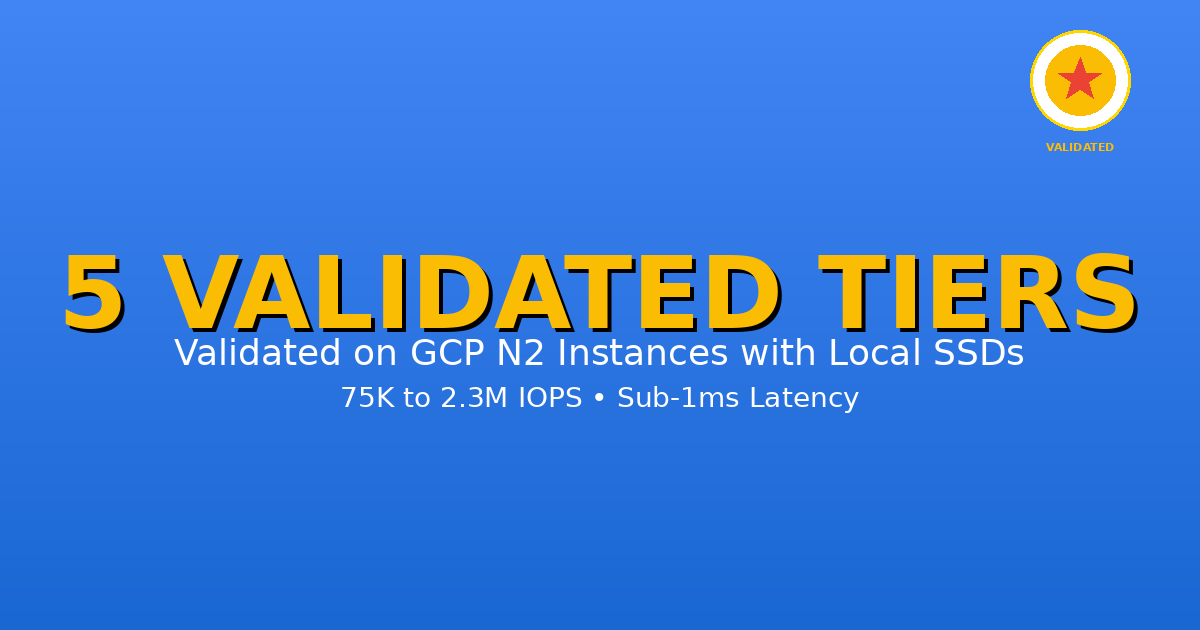
GCP GCP's N2 instances remain excellent—good NVMe options with strong networking (32 Gbps on n2-standard-32). But their local NVMe comes in smaller increments per core. A comparable n2-standard-4 with local SSDs doesn't match Laosv4's capacity.
GCP advantage: Better network bandwidth, more mature ecosystem
Azure advantage: Ridiculous NVMe capacity, even on small instances
AWS: Steady and Proven
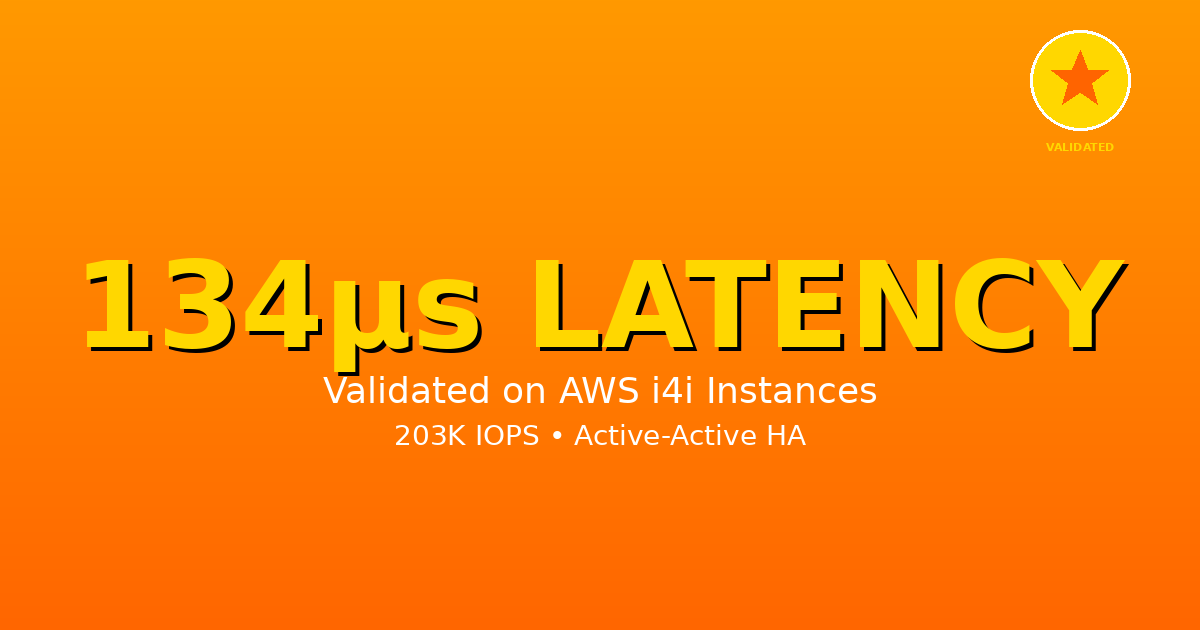
AWS The AWS i3en/i4i series are rock-solid. Great for production workloads that value reliability over bleeding-edge capacity. But instance pricing for equivalent NVMe capacity is higher than Laosv4.
AWS advantage: Battle-tested, excellent docs, wide availability
Azure advantage: More NVMe capacity per dollar
The Quota Wars: Scarcity = Success
Want to know if a cloud product is actually good? Check the quota limits. Laosv4 quotas are ridiculously hard to get.
Try spinning up an L32aos_v4 in a popular region like East US—instant quota hit. Submit a request—wait 2-3 weeks for approval. This isn't Azure being stingy; it's a signal that demand is crushing supply.
The old Lsv2? Never had quota problems because nobody wanted them. Laosv4? Can't build capacity fast enough to meet demand.
Production Planning Tip
If you're planning production deployments on Laosv4, request quotas 3-4 weeks early. Don't wait until launch day. The "hot" status of these instances is real—they're capacity-constrained across most regions.
The Network Reality Check
Before we get carried away, let's address the weakness: networking still lags behind GCP.
- L4aos_v4 (4 cores): 10 Gbps network
- L32aos_v4 (32 cores): 16 Gbps network
Compare to GCP n2-standard-32 at 32 Gbps, or AWS i4i.8xlarge at 18.75 Gbps. Azure's networking is functional but not leading-edge.
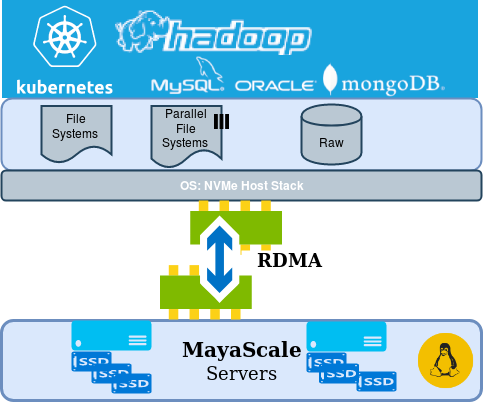
This matters for distributed storage. When we tested MayaScale on L4aos_v4 with active-active replication, write IOPS peaked at 99K before the 10 Gbps network became the bottleneck. The NVMe drives could push more—but network replication consumed the bandwidth budget.
For single-node workloads (local databases, build caches, staging areas), the network is fine. For multi-node distributed storage, you'll hit the ceiling faster than you'd like.
Azure's High-Bandwidth Secret Weapon
But wait—Azure has a solution for bandwidth-hungry workloads: the DNSv6 and other N-series instances.
These aren't storage-optimized, but they support NVMe temp disks and deliver up to 80 Gbps networking on larger SKUs. If you need both massive NVMe and high network bandwidth, N-series is your answer.
Azure Strategy Pick your bottleneck:
- Storage bottleneck? → Laosv4 (max NVMe capacity)
- Network bottleneck? → N-series (high bandwidth + NVMe)
- Both? → N-series (pay premium for both)
Real-World Testing: MayaScale on Laosv4
We've been running MayaScale across all three clouds, and Laosv4 delivers some impressive numbers:
L4aos_v4 Performance (4 cores, 2.88 TB NVMe)
- Read latency: 139 μs (0.139 ms) at QD1
- Write latency: 222 μs (0.222 ms) at QD1
- Peak read IOPS: 352K (sub-1ms latency)
- Peak write IOPS: 77K (sub-1ms latency)
These are phenomenal numbers for a 4-core instance. The write IOPS ceiling at 77K is network-limited, not storage-limited—the NVMe drives can do more.
Where Laosv4 Excels
Perfect for:
- Single-node databases (PostgreSQL, MySQL, MongoDB primaries)
- Build systems and CI/CD pipelines needing fast local cache
- Data staging and ETL processing with massive temp storage needs
- In-memory databases with large persistent backing stores
- Development and testing environments with real production-like storage
Where N-Series Wins
Choose N-series when:
- Running distributed storage (MayaScale, Ceph, GlusterFS) across multiple nodes
- Heavy network replication or synchronization requirements
- Applications need both NVMe and 40+ Gbps networking
- Cost is secondary to raw performance
The Economics: NVMe Per Dollar
Here's where Azure's Laosv4 strategy becomes clear: they're competing on storage capacity per dollar, not overall compute price.
For workloads that need massive local storage but moderate compute, Laosv4 absolutely crushes the competition. You're getting 2.88 TB of NVMe on a 4-core instance for a fraction of what an equivalent capacity configuration would cost on GCP or AWS.
Storage-Dense Workloads Just Got Cheaper
If your bottleneck is storage capacity (not compute or network), Laosv4 might cut your cloud bill by 40-60% compared to previous options. That's transformative for data-intensive applications.
The Multi-Cloud Verdict
Azure's Laosv4 fundamentally changes the conversation. For years, the answer to "where should we run storage-intensive workloads?" was "GCP or AWS." Now Azure has a legitimate—and in some cases superior—answer.
Maximum NVMe Capacity
2.88 TB on 4-core
Best for storage-dense, single-node workloads
Balanced Performance
NVMe + 32 Gbps
Best for distributed multi-node storage
Production Stability
Proven reliability
Best for mission-critical workloads
Bottom Line: Competition Works
Azure's Laosv4 series proves that cloud competition benefits customers. After years of playing catch-up in storage-optimized instances, Azure came back with a vengeance—delivering NVMe capacity that's frankly ridiculous in the best way.
Yes, the network bandwidth still lags GCP. Yes, quotas are tight. But Azure fundamentally changed what customers can expect from a "storage-optimized" instance. 2.88 TB on a 4-core VM is a game-changer.
The New Reality
For NVMe capacity per dollar: Laosv4 wins decisively
For balanced NVMe + networking: GCP N2 still leads
For production reliability: AWS i4i remains king
For max bandwidth + NVMe: Azure N-series at premium price
Pick based on your actual bottleneck. And whatever you choose, appreciate that Azure's aggressive move with Laosv4 is forcing everyone to compete harder. We all win.
The cloud NVMe wars just got interesting. Azure is back in the fight, and they're swinging hard.